
Automatic piston sausage stuffer/filler FP30: real advantages and when to make the move
The automatic piston sausage stuffer: what it is and what it delivers
The automatic piston sausage stuffer is the production equipment designed for environments where precision, speed and product consistency are non-negotiable requirements. Unlike a conventional piston stuffer, where the operator manually controls both the filling rhythm and the twist point of every piece, the automatic version transfers that control to the software: the machine executes each cycle under the same conditions, regardless of the operator and their physical state across the shift.
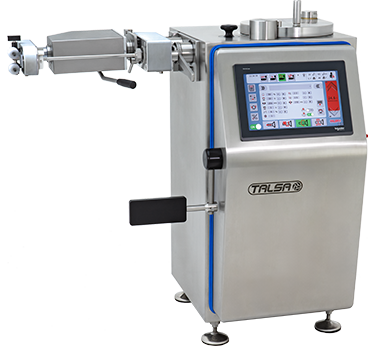
With an automatic hydraulic piston sausage stuffer, that control passes to the software. The machine defines each portion weight with high precision, manages filling speed, counts produced pieces and — on models with twisting — rotates the horn automatically between each sausage. Product consistency is no longer dependent on the operator: it becomes a constant of the process.
Talsa, an industrial meat processing machinery manufacturer with a presence in over 60 international markets, develops its line of automatic piston sausage stuffers in Spain with decades of experience in the meat processing industry and first-class European components.
Manual vs. automatic sausage stuffer: key differences
| Manual piston sausage stuffer | Automatic piston sausage stuffer |
| Operator controls portion size by feel | Each portion programmed to a precise target weight |
| Operator twists each sausage manually | Digital twister rotates automatically the configured number of times |
| Speed depends on the operator’s physical rhythm | Constant speed and pressure throughout the entire production run |
| Piece-to-piece variability is inherent to manual operation | Every piece: same weight, same shape, same twist point |
| Operator fatigue directly affects product quality | Operator loads and supervises; machine produces autonomously |
| ~80–100 portions/min with skilled operator | Up to 300/min with twister; up to 350/min with motorised casing arm |
| Usually single-phase, simple installation | Three-phase only; qualified electrician required |
| Ready in minutes | Guided start-up of 45–90 min on first installation |
Over an 8-hour shift, an automatic sausage filling machine can produce between 3 and 5 times more pieces per shift than a manual stuffer of the same format, with consistent product homogeneity that does not depend on the operator’s physical effort.
When does investing in an automatic stuffer make sense?
An industrial automatic sausage stuffer is not the right solution for every operation. It makes sense to consider it when at least one of these situations applies:
- Production volume has exceeded what a manual stuffer can handle without compromising quality or output. Operator fatigue has become a limiting factor.
- Product consistency is a commercial or quality requirement: the customer expects constant weight, uniform presentation and a defined twist point on every piece.
- Production includes linked sausages with twisting, and manual twisting creates a bottleneck or excessive workload for the operator.
- Multiple products are run in the same shift and parameters need to switch quickly without manual recalibration on each change.
- Production speed needs to increase without adding more operators to the stuffing process.
- Delicate natural casings are used and require constant, controlled tension during filling — difficult to guarantee with manual operation.
If production is small and occasional, products are always large-format without twisting, or the current level of automation comfortably covers demand, it may not be the right moment. The right decision is not always the most advanced machine — it is the right machine for the current stage of production.
The Talsa FP30: industrial technology built into every unit
Within the category of automatic piston sausage stuffers, the Talsa FP30 incorporates a set of technological features that place it at a level of reliability and connectivity typical of high-end industrial machinery:
The FP30 range is available in three versions to suit different production needs: the FP30e, the standard version for portioning and dosing or non-linked sausages; the FP30t, fitted with an automatic linker for continuous chain sausage production; and the FP30s, which also includes a motorised horn support for working with delicate natural casings at high throughput. All three versions share the same technological platform and the same level of industrial finish.
| Feature | What it means to you | |
| ◼ | 15″ Schneider touchscreen | Large 15-inch touchscreen displaying all information simultaneously: production data, alarms, errors, diagnostics and access to the instruction manual directly from the panel. Intuitive, available in 4 languages. |
| ◼ | Interactive recipe management | All production parameters — weight, speed, twists, ramp — are saved as recipes and recalled with a single touch. Changing products requires no recalibration: just select the recipe. |
| ◼ | IO-Link communications (Balluff, Germany) | Internal digital communications use IO-Link technology from Balluff, the latest-generation industrial standard for sensors and actuators. The result: more reliable signals, precise diagnostics and fewer faults from interference. |
| ◼ | Hydac (Germany) hydraulic components and Schneider Electric | The hydraulic and electrical circuits use components from Europe’s leading industrial brands: Hydac for hydraulics and Schneider Electric for control electronics — the same component manufacturers used in high-end industrial machinery. |
| ◼ | Full AISI 304 stainless steel construction | Exterior and interior construction in AISI 304 stainless steel: frame, fasteners and all possible components. Smooth surfaces with CE radii for easy cleaning and compliance with food hygiene regulations. |
| ◼ | Remote support via internet (Talsa Remote Support Cloud) | The machine connects securely via VPN to Talsa’s remote support cloud. The technician can access the control panel remotely to diagnose and resolve issues in real time — no site visit required. |
| ◼ | Industry 4.0 and network integration | Integrated Ethernet RJ45 port for connection to local networks or the internet. Compatible with monitoring systems and Industry 4.0 digital solutions for process integration, predictive maintenance and custom solutions. |
| ◼ | Automatic predictive maintenance alerts | The system logs maintenance alerts and displays them on screen before they become failures. The operator receives advance warnings — no unplanned downtime. |
This combination of premium components, proprietary software and remote connectivity is not standard in the FP30’s price range. It is the result of applying industrial food processing machinery standards to a machine also designed for medium-scale operations.
How it works: the production cycle
The operating cycle of an automatic hydraulic piston sausage filler follows four repeating phases:
- Loading: the operator fills the stainless steel cylinder with the meat mixture, pressing in small batches to eliminate air pockets that could burst the casing during production.
- Pre-compression: the hydraulic system compresses the mixture to expel residual air before production begins. This ensures the first portions are as precise as the last.
- Portioning and filling: the piston pushes the mixture through the horn at the exact configured weight, at a constant speed. In continuous mode, production is uninterrupted between portions.
- Automatic twisting (FP30t and FP30s models): the horn rotates the programmed number of times between each portion, creating the twist point without any operator input.
Beyond sausage making: other applications and accessories
Although its primary application is sausage production, the FP30 can also be used to dose and portion any type of food mass: pâtés, meat preparations, high-protein masses or other products requiring precise, repeatable portioning. Its hydraulic piston system delivers the same precision regardless of the type of mass, provided it has an appropriate consistency for stuffing. In addition, the FP30 range offers complementary accessories that extend its versatility, such as the jar-filling funnel and the burger mould, allowing the machine to be adapted to different formats and products without additional equipment.
Start-up and support: the accompaniment that makes the difference
An automatic piston sausage stuffer requires a guided start-up. Unlike a conventional stuffer, the automatic version needs software configuration, weight calibration, operator training and verification of the three-phase electrical installation.
At Talsa, meat processing equipment manufacturer, every machine ships with a complete kit that includes a quick start guide, step-by-step start-up videos, a parameter guide and a fault-finding decision tree, as well as the full operation manual. Talsa distributors are trained to accompany the customer from installation through to full production. And thanks to Talsa Remote Support — a remote support system built into the machine that enables access to equipment data via Ethernet connection — any incident can be precisely diagnosed and resolved in real time with direct access to the control system, with no travel required.
Conclusion
The automatic piston sausage stuffer is the right investment when production volume, consistency requirements or speed demands have exceeded what manual equipment can sustainably deliver. At that point, automating is not an expense — it is the condition for continued growth with quality.
Talsa manufactures automatic hydraulic sausage stuffers designed and built in Spain, with industrial technology and structured support included. If you are considering making the move, contact your local Talsa distributor.
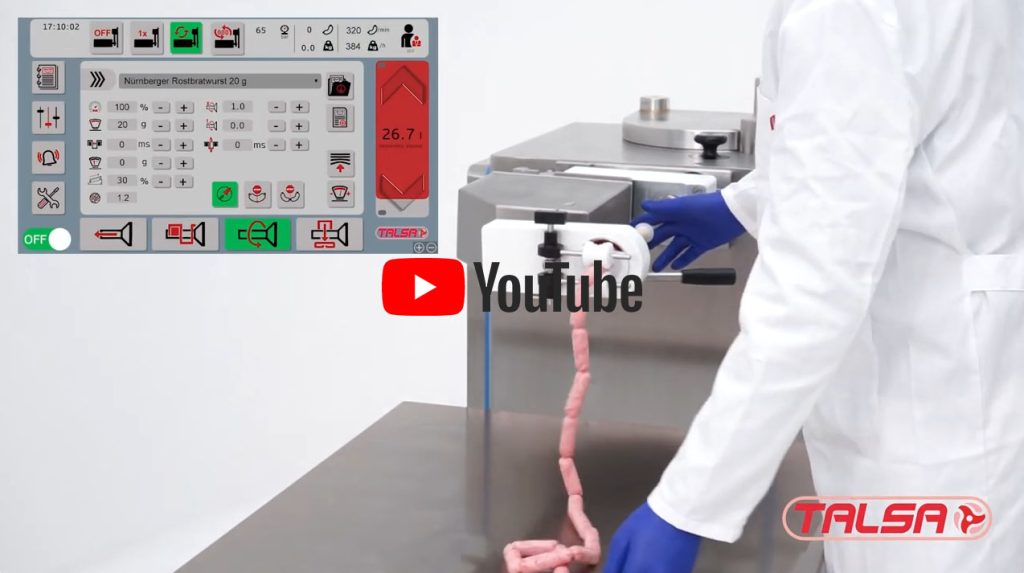
▶ Watch the Talsa FP30 automatic sausage stuffer in action in the video below.

Social
About The Author
